
Preparing Your Appliances for a Colorado Winter
Colorado winters hit differently than winters in most places. It's not just cold. It's the combination of hard freezes, dry air, temperature swings that can span 50 degrees in a single day, and storms that knock out power without much warning. Fort Collins can be 60 degrees in November and buried in snow by the next week. That kind of weather creates specific problems for appliances that people in milder climates don't have to think about. Here's what to check before winter gets serious.
Protect Washer Hoses from Freezing
If your laundry setup is in a garage, unfinished basement, or any space that doesn't stay heated in winter, your washer hoses are at risk. The rubber supply hoses connecting the wall valves to the back of the machine can freeze when temperatures in those spaces drop below 32 degrees. A frozen hose that thaws and cracks, or one that just can't supply water to the machine, turns into either a leak or a washer that won't run.
A few steps to address this: first, check whether your laundry space actually gets cold. On a night that drops below 20°F in Fort Collins, stick a thermometer out there. You might be surprised. If the space is regularly dipping below freezing, pipe insulation on the supply lines is inexpensive and easy to install. It's foam sleeves that slide over the pipes and help hold ambient heat in.
If the space is borderline cold, leave the cabinet doors under the sink open on the coldest nights. The same principle applies near washer hookups against exterior walls. If there's a cabinet or panel that can be opened to let warmer air circulate toward the pipes, do it.
For outdoor hoses connected to the house: those should already be disconnected and drained before the first freeze, but also shut off the interior valve that supplies any outdoor spigot. Water left in those lines expands when it freezes.
Dryer Lint Buildup and Winter Laundry Demand
Winter in Fort Collins means heavier laundry loads. Blankets, coats, hoodies, and thick layers go through the dryer constantly from November through March. That increased use pushes more lint through the system than any other time of year.
If you haven't had the dryer vent cleaned recently, winter is the worst time to find out it's restricted. A partially clogged vent means longer drying times, a dryer that runs hot to the touch, and lint accumulating in places it shouldn't be, including inside the dryer cabinet around the heating element. That's a fire hazard.
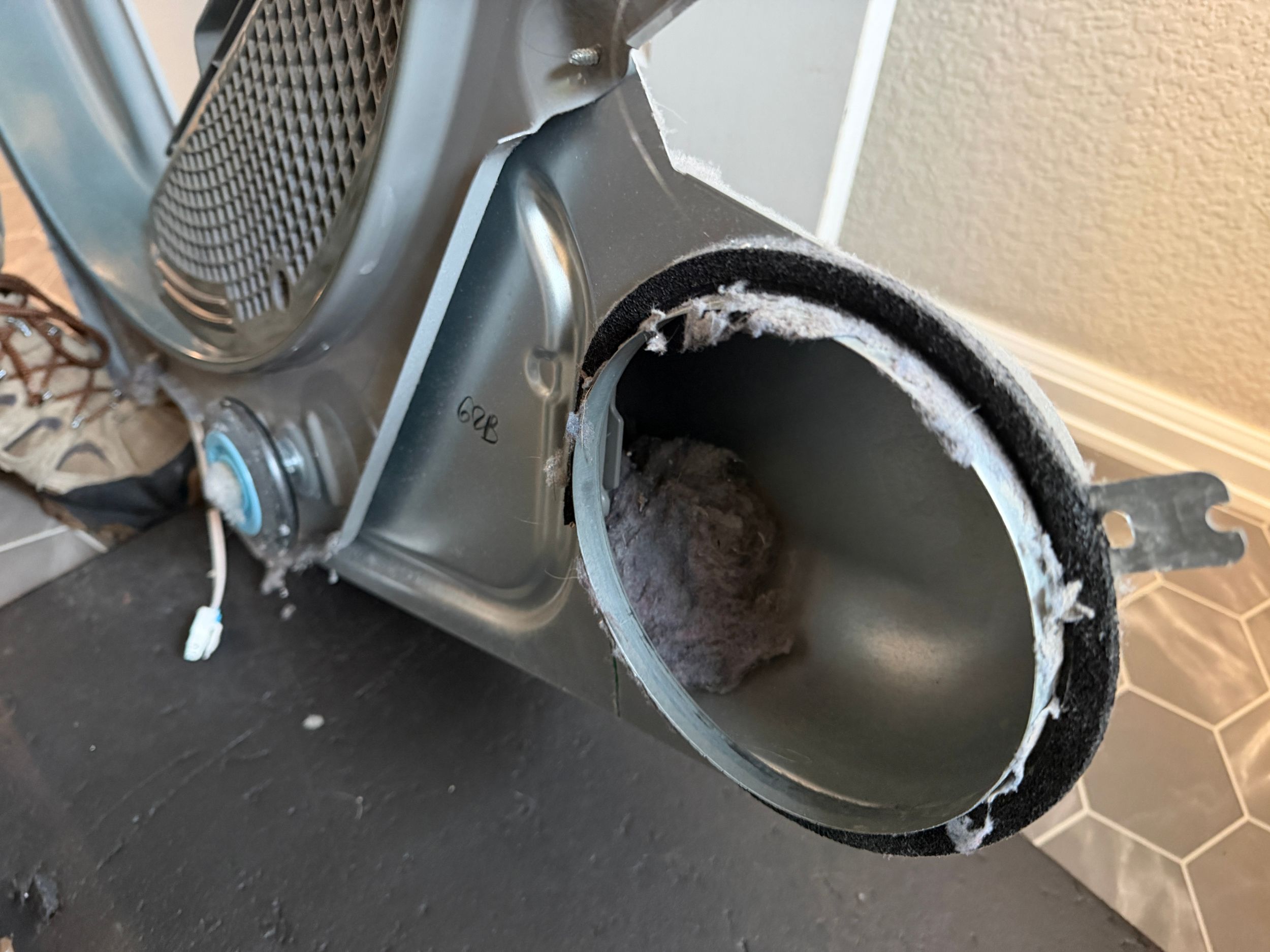
Before winter laundry season ramps up, pull the dryer away from the wall and check the transition duct, the flexible section connecting the dryer to the wall vent. Make sure it's fully connected at both ends, not kinked, and not crushed behind the machine. A duct that's come loose or gotten pinched during the summer is going to cause problems once you're running the dryer daily.
Also check the exterior vent flap on the outside of the house. Make sure it opens freely and isn't blocked by debris, leaves, or animal nests. In Fort Collins, wasps and birds like to build in vent openings during the warmer months, and you won't notice until the dryer starts struggling in winter.
If you can't remember the last time the vent was professionally cleaned, schedule it before the heavy-use season. RMAS handles dryer vent cleaning and can combine it with any dryer maintenance or repairs at the same time.
Refrigerator in the Garage
A lot of people in Northern Colorado have a second refrigerator or a beer fridge in the garage. It seems like a natural place for it. Out of the way, doesn't take up space inside the house. The problem is that garage refrigerators face a specific technical challenge in winter.
Most refrigerator thermostats work by sensing the ambient temperature and deciding when to run the compressor. When your garage drops below 35 to 40°F, the ambient temperature outside the refrigerator is already as cold as the inside is supposed to be. The thermostat may not cycle the compressor at all, because it reads the room as "already cold enough." The result is that the freezer compartment in a combination fridge-freezer stops getting cold enough, and frozen items can start to thaw even in a cold garage.
Some manufacturers sell a "garage kit," a small heater that installs near the thermostat to keep the sensing environment slightly warmer than the ambient garage temperature, tricking the thermostat into running normally. If your garage fridge is a modern unit, check whether your manufacturer offers one for your model.
If you have a standalone garage refrigerator you rely on through winter, keep a thermometer inside and check it periodically. You may find the interior temperature varies significantly depending on outdoor temperatures, not because the fridge is broken but because of how the thermostat responds to cold ambient conditions.
Chest Freezer Placement
A standalone chest freezer in an unheated garage handles cold better than a refrigerator does, because it just needs to maintain cold rather than regulate temperature actively. But Colorado winters still create some considerations.
When the garage gets very cold, say single digits, a chest freezer doesn't have to work hard at all to keep food frozen. That's generally fine. The issue comes with temperature swings. Northern Colorado can go from -5°F overnight to 45°F by afternoon. That's a 50-degree swing, and repeated cycles of this cause condensation inside the freezer cabinet as moisture-laden air gets drawn in when the lid is opened and then condensates on the cold interior surfaces when temperatures drop again. Over time this causes frost buildup and can affect the cabinet seal and insulation.
Keeping the freezer in a location that moderates temperature swings, like an enclosed garage rather than one that's fully open on one side, or a utility room rather than a detached shed, helps reduce the cycling stress. Don't store a chest freezer directly against an exterior wall where it's exposed to the worst temperature swings through the building envelope.
Power Outages
Colorado winter storms knock out power. This is a fact of life in Northern Colorado, and it's worth thinking about what it means for your refrigerator and freezer before you're in the middle of it.
Keep the refrigerator and freezer doors closed. The refrigerator will hold a safe temperature for about four hours if you don't open it. A full freezer will hold safe temperatures for approximately 48 hours, and a half-full freezer for around 24 hours. The mass of frozen food is acting as a thermal buffer. Opening the door speeds up the temperature loss significantly.
Food safety guidelines are worth knowing: the refrigerator contents are safe if the interior stays at or below 40°F. Anything that sits above 40 degrees for more than two hours should be discarded. When power comes back, check whether the fridge actually got warm or whether it held temperature. An interior thermometer takes the guesswork out of this.
When power returns, be aware of voltage spikes. Utility power restoration can involve brief surges, and modern appliances with electronic control boards are vulnerable to surge damage. A whole-house surge protector installed at your electrical panel is the best solution. Individual outlet surge protectors on major appliances are a reasonable secondary measure.
General Winter Tips
Keep major appliances away from exterior walls if possible. Appliances that sit against an outside wall in a poorly insulated home, particularly in older Fort Collins housing stock, are exposed to cold that affects their performance and, in the case of water lines, freeze risk.
Check for drafts near appliance hookups. The hole in the wall where supply hoses and drain lines pass through is often not fully sealed. In winter, cold air coming through those gaps chills the immediate area around the hookup point. A little expanding foam or caulk around those penetrations costs almost nothing and makes a real difference in unheated or semi-heated spaces.
If you have appliances that will sit unused through winter, like a cabin, a rental property that goes vacant, or a vacation home, it is worth shutting off the water supply and draining the washer hoses entirely rather than hoping the heat stays on and nothing freezes.
Most of this preparation takes less than an hour to work through. The payoff is not having to deal with a cracked washer hose, a lint-clogged dryer, or a garage fridge full of thawed food in the middle of January.
I'm Jake with RMAS Appliance Repair in Fort Collins. If you run into something this winter that needs more than basic maintenance, give me a call at (970) 443-4367. I serve customers throughout Northern Colorado and can usually get out to you quickly.
Need Professional Help?
If your appliance needs more than a DIY fix, I can help.
Related Articles
Your Spring Appliance Maintenance Checklist for Northern Colorado
Spring is a good time to do a quick walk-through of your appliances. Not because something is broken, but because a little attention now prevents a breakdown later when you actually need things working. Temperatures are climbing in Fort Collins, laundry piles up with spring cleaning, and appliances that coasted through winter are about to work harder. Here's what to check.
Why Is My Refrigerator Leaking Water? Causes and Fixes
You notice a puddle on the kitchen floor in front of the fridge. Or you open it up and find water pooling at the bottom of the fresh food section. A refrigerator leaking water is one of the most common calls I get here in Fort Collins. The good news is that several of the causes are things you can check and fix yourself. Some of them are not.
Appliance Repair in Fort Collins: Meet Jake at RMAS
If you're looking for appliance repair in Fort Collins, you should know what you're getting when you call RMAS.
Need appliance repair in Fort Collins?
Give me a call at (970) 443-4367 or fill out the contact form.