
What to Do When Your Dishwasher Won't Drain

You open the dishwasher after a cycle and there's an inch of grimy water sitting at the bottom. It's a frustrating problem, and it's also one of the most common calls I get. The good news is that a dishwasher that won't drain is often something you can fix yourself without calling anyone.
Start with the simple stuff first.
Check the Filter
Most people have no idea their dishwasher has a filter. It sits at the bottom of the tub, usually under the lower spray arm. It catches food debris so it doesn't recirculate onto your dishes or clog the drain.
When that filter gets packed with food and grease, water can't drain past it. This is by far the most common reason I see standing water in dishwashers.
Pull the lower rack out. Look at the bottom of the tub. There's usually a cylindrical filter that twists out and a flat mesh screen underneath it. Remove both, rinse them under warm water, and scrub off any buildup with a soft brush. Don't use anything abrasive that might damage the mesh.
Reinstall them and run a short cycle. A lot of the time, that's all it takes.
Check for a Kinked Drain Hose
The drain hose runs from the pump underneath the dishwasher to your sink drain or garbage disposal. It can kink, especially if the dishwasher has been moved or if someone was working under the sink recently.
Pull the dishwasher out slightly if needed, or look underneath from the front. Trace the hose and check for any bends or kinks that would restrict flow. Straighten it out if you find one.
The hose should also loop up high under the sink before connecting to the drain. This high loop prevents dirty sink water from flowing back into the dishwasher. If it's sagging down low, that can cause drainage problems too.
Check the Garbage Disposal Connection
If your dishwasher drains into a garbage disposal, there's a plug on the disposal inlet that sometimes causes issues. When a disposal is installed new, there's a knockout plug in the dishwasher inlet port. It's supposed to be removed during installation. If it wasn't, your dishwasher has been draining into a blocked port.
This is more common than you'd think, especially if a new disposal was recently installed. Before doing anything, turn off the power to the disposal at the circuit breaker. Do not just flip the wall switch. Then disconnect the drain hose from the disposal and check the inlet port. If there's a plastic plug inside, knock it out with a screwdriver and hammer, then clear out the debris.
Also make sure to run the disposal before running the dishwasher. A full disposal can back up into the dishwasher drain line.
When the Pump Is the Problem
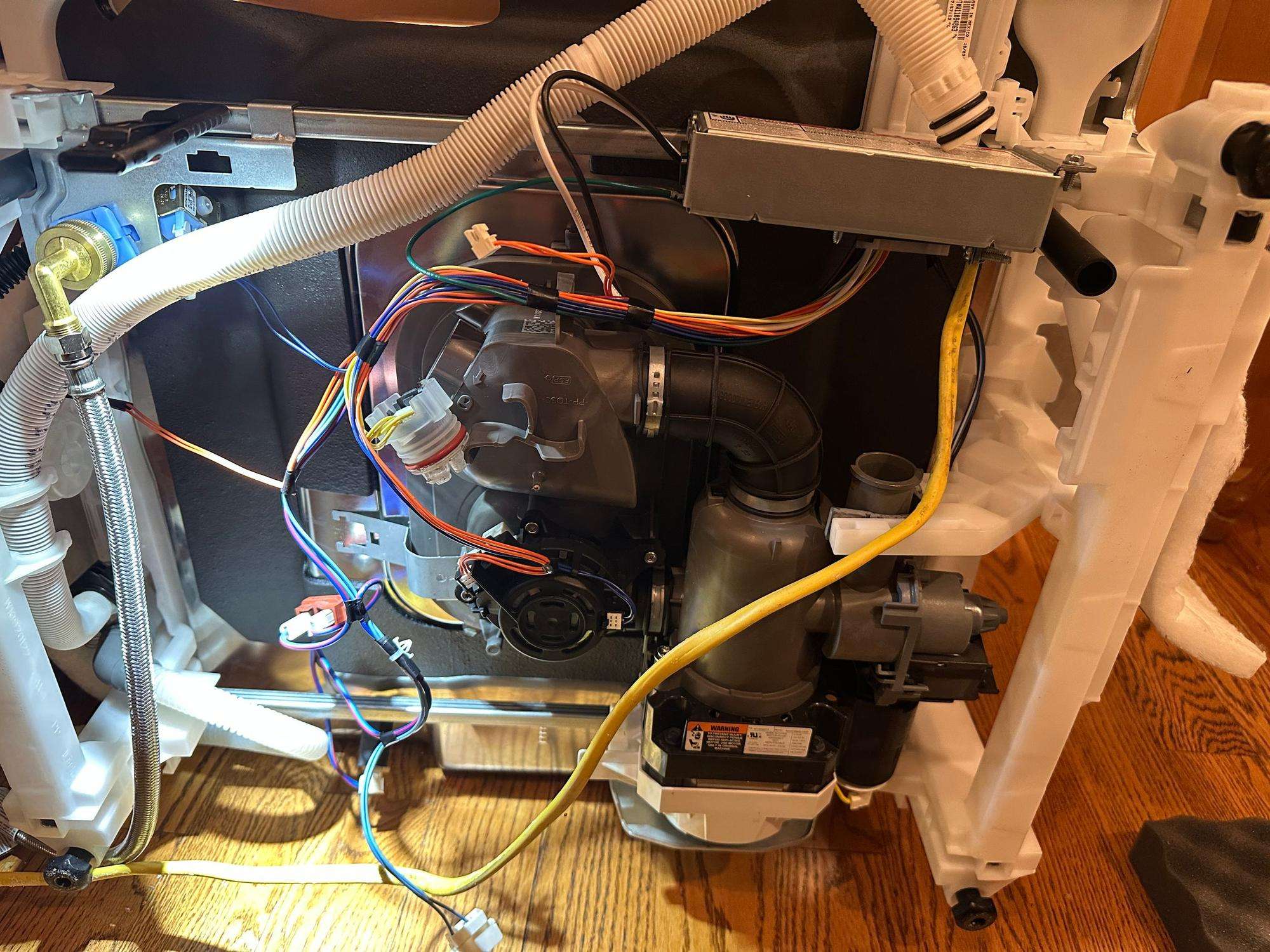
If the filter is clean, the hose looks good, and the disposal connection is clear, the issue is likely the drain pump or the pump motor.
The drain pump is what actually forces water out of the tub. When it fails, water just sits there with nowhere to go. You might hear humming during the drain portion of the cycle with no actual water moving, or you might hear nothing at all.
Pump failures can also be caused by a foreign object blocking the impeller. Broken glass, a piece of bone, or a small utensil can jam the pump without killing it entirely. Sometimes clearing the obstruction is enough. Other times the pump itself needs to be replaced.
Getting to the pump requires pulling the dishwasher out and accessing the bottom of the unit. At that point you're into a real repair, and it's worth calling a technician unless you're comfortable with appliance work.
A Few Other Things to Try First
Before assuming it's mechanical, run the dishwasher again and listen carefully during the drain cycle. Does the pump run? Is there any gurgling at the sink? These sounds tell you a lot about where the blockage is.
Also check your sink drain itself. If the sink is slow to drain, a partial clog in the shared drain line could be backing water up into the dishwasher.
I'm Jake with RMAS Appliance Repair, based in Fort Collins. I work on dishwashers throughout Northern Colorado and I'm usually able to get out quickly for service calls.
If you've worked through the basics and still have standing water, give me a call at (970) 443-4367. Most dishwasher drain problems are fixable and affordable to repair. Let's figure out what's going on before you start pricing new machines.
Need Professional Help?
If your appliance needs more than a DIY fix, I can help.
Related Articles
Your Spring Appliance Maintenance Checklist for Northern Colorado
Spring is a good time to do a quick walk-through of your appliances. Not because something is broken, but because a little attention now prevents a breakdown later when you actually need things working. Temperatures are climbing in Fort Collins, laundry piles up with spring cleaning, and appliances that coasted through winter are about to work harder. Here's what to check.
Why Is My Refrigerator Leaking Water? Causes and Fixes
You notice a puddle on the kitchen floor in front of the fridge. Or you open it up and find water pooling at the bottom of the fresh food section. A refrigerator leaking water is one of the most common calls I get here in Fort Collins. The good news is that several of the causes are things you can check and fix yourself. Some of them are not.
Appliance Repair in Fort Collins: Meet Jake at RMAS
If you're looking for appliance repair in Fort Collins, you should know what you're getting when you call RMAS.
Need appliance repair in Fort Collins?
Give me a call at (970) 443-4367 or fill out the contact form.