
Why Is My Freezer Not Freezing? Causes and Fixes
Your freezer is supposed to hold 0°F and keep everything rock solid. When ice cream turns soft, meat starts to thaw, or you notice the freezer feels cool instead of cold, something has gone wrong. This is one of the more common service calls I get here in Fort Collins, and it covers a wide range of causes. Some are simple fixes you can handle in five minutes. Others require a technician.
Here is what to look at, starting with the most obvious and working toward the most serious.
1. Thermostat Set Wrong or Bumped
I see this more often than I probably should. Someone reaches into the freezer and accidentally nudges the temperature dial, or a kid adjusts it out of curiosity. The setting changes, the freezer backs off on cooling, and a few hours later you have soft ice cream and a confused homeowner.
Before you do anything else, check the thermostat setting. The ideal temperature for a freezer is 0°F. If your unit has a dial numbered 1 through 7 or 1 through 9, higher numbers mean colder. If it has an electronic display, it should read 0°F or -18°C. Adjust it if needed and wait 24 hours before deciding whether you have a real problem.
2. Dirty Condenser Coils
The condenser coils release heat from the refrigerant as part of the cooling cycle. When those coils get coated with dust, pet hair, and lint, they cannot release heat efficiently. The compressor has to work harder to compensate, temperatures creep up, and eventually the freezer loses its ability to maintain 0°F.
Most chest freezers and upright freezers have condenser coils either on the back of the unit or underneath behind a kick plate. Pull the unit out from the wall or remove the kick plate and take a look. If the coils are covered in debris, that is your problem. A vacuum with a brush attachment will clear most of it. Do this once a year and you will avoid this issue entirely.
3. Failed Evaporator Fan Motor
Every freezer has an evaporator fan that circulates cold air throughout the cabinet. When that fan motor fails, cold air stays concentrated near the evaporator coils and does not move through the rest of the freezer. The unit runs but temperatures stay warm because the air is not circulating.
Signs that the fan motor has failed: the freezer is running and you can hear the compressor, but there is no airflow when you open the door, or you hear a buzzing, clicking, or grinding sound coming from inside the freezer. In some cases the fan blade has iced over and is hitting the housing.
This is not a DIY repair for most people. The evaporator panel needs to come off, the motor needs to be tested and replaced with the correct part for your model. Call a technician.
4. Defrost System Failure
Every modern frost-free freezer runs a defrost cycle periodically, usually once or twice a day, to melt any frost that builds up on the evaporator coils. If the defrost heater, the defrost timer, or the defrost thermostat fails, frost builds up on the coils unchecked. Eventually the coils become completely encased in ice and cold air cannot pass through them. The freezer runs constantly but cannot cool.
You can sometimes diagnose this yourself. If you remove the back panel inside the freezer and find the evaporator coils completely coated in a solid wall of frost or ice, the defrost system has failed.
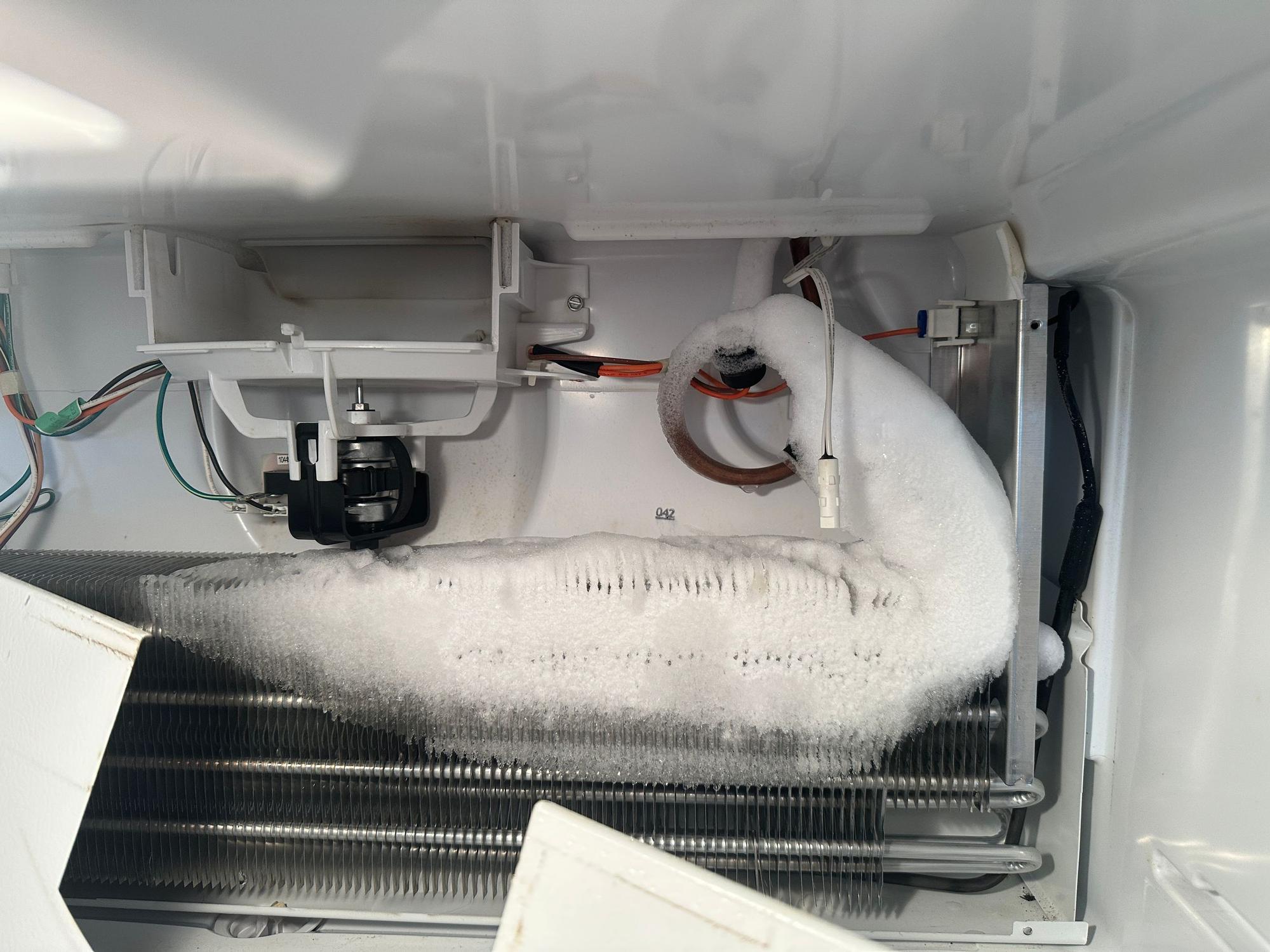
A temporary fix is to manually defrost the unit by unplugging it and letting it thaw for 24 to 48 hours. If it cools properly after that but the frost builds back up within a few days, you have confirmed a defrost system failure and need the right component replaced.
Which component is at fault requires testing. That is a technician call.
5. Door Gasket Not Sealing
The rubber gasket around the freezer door keeps warm air out. When it wears out, tears, stiffens, or pulls away from the door liner, warm humid air gets into the cabinet continuously. The freezer works overtime trying to compensate, but it cannot keep up. Frost and ice also accumulate in the wrong places as that moisture freezes where it should not.
The dollar bill test works well here. Close the freezer door on a dollar bill and try to pull it out. If it slides out with little resistance, the seal is not tight at that spot. Work your way around the entire perimeter of the door checking for weak spots.
A warped or torn gasket needs to be replaced. In some cases the door itself has warped and the gasket cannot seat properly regardless of condition. New gaskets are model-specific and usually not expensive. The installation is manageable for most people.
6. Compressor Failing
The compressor is the heart of the cooling system. It pressurizes the refrigerant and drives the entire refrigeration cycle. When it starts to fail, the freezer loses its ability to get cold and stay cold. This is the most serious and most expensive cause on this list.
Signs of a failing compressor: the freezer runs constantly but temperatures are warm, you hear a clicking sound as the compressor tries to start and fails, or the unit cycles on and off in short bursts rather than running steady. The compressor itself will feel hot to the touch at the back of the unit even when the freezer is not cold.
Compressor replacement is expensive. On most residential freezers, the cost of a new compressor plus labor often approaches or exceeds the cost of a replacement unit. Before committing to that repair, get an honest assessment of whether the machine is worth it. A freezer that is more than ten years old and has a failed compressor is usually a replacement candidate.
A freezer that is not freezing properly is worth diagnosing quickly. Food loss adds up fast, and some of the underlying causes, like a failed defrost system, will only get worse and potentially damage the unit if left alone.
If you have worked through the basics and the problem is still there, or if you want a second set of eyes on it before buying parts, give me a call. I'm Jake with RMAS Appliance Repair in Fort Collins. I service freezers and refrigerators throughout Northern Colorado and can usually get out to you within a day or two.
Reach me at (970) 443-4367.
Need Professional Help?
If your appliance needs more than a DIY fix, I can help.
Related Articles
Your Spring Appliance Maintenance Checklist for Northern Colorado
Spring is a good time to do a quick walk-through of your appliances. Not because something is broken, but because a little attention now prevents a breakdown later when you actually need things working. Temperatures are climbing in Fort Collins, laundry piles up with spring cleaning, and appliances that coasted through winter are about to work harder. Here's what to check.
Why Is My Refrigerator Leaking Water? Causes and Fixes
You notice a puddle on the kitchen floor in front of the fridge. Or you open it up and find water pooling at the bottom of the fresh food section. A refrigerator leaking water is one of the most common calls I get here in Fort Collins. The good news is that several of the causes are things you can check and fix yourself. Some of them are not.
Appliance Repair in Fort Collins: Meet Jake at RMAS
If you're looking for appliance repair in Fort Collins, you should know what you're getting when you call RMAS.
Need appliance repair in Fort Collins?
Give me a call at (970) 443-4367 or fill out the contact form.